SBT 合规话术库 · Skin Barrier Theory Talking-Points Library
目录 · Contents
0 · 使用说明 / How to use this library
本话术库供宝措卤阳® 的工程师、客服、门店导购与代销伙伴统一使用。所有表述以备案成分表与真实配方为依据,不得夸大、不得承诺疗效。每条话术均给出中文与英文两版,便于跨境与内容创作复用。
This library is for engineers, customer-service staff, in-store advisors and distribution partners of BAOCUO LUYANG®. Every statement must be grounded in the filed ingredient list and the actual formulation—no exaggeration, no efficacy claims. Each talking point is given in both Chinese and English for cross-border and content reuse.
使用三原则:讲配方、讲机制、讲感受,不讲疗效;涉及数据须引用可公开来源;遇监管红线(见第 7 节)一律止步[48][49]。
Three rules of use: speak about formulation, mechanism and experience—never about curing; cite publicly verifiable sources for any data; and stop at once at any regulatory red line (see §7)[48][49].
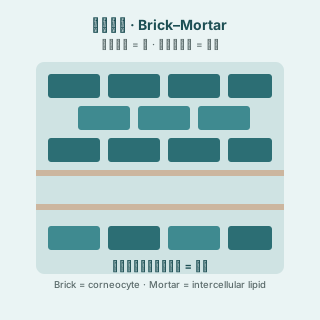
Foundation: every claim rests on the brick–mortar of real formulation.
1 · 理论总览 / Theory overview
SBT(护肤城墙理论,Skin Barrier Theory)把皮肤视作一道需系统修护的“城墙”:角质形成细胞是砖,细胞间脂质(神经酰胺、胆固醇、脂肪酸)是灰浆。护肤不是功效成分的堆叠,而是对“评估—补充—重建—耐受”的闭环修护[2][3]。
SBT (Skin Barrier Theory) frames the skin as a "city wall" needing systematic repair: corneocytes are the bricks, and intercellular lipids (ceramides, cholesterol, fatty acids) are the mortar. Skincare is not the piling-up of actives, but a closed loop of assess–supplement–rebuild–acclimate[2][3].
它继承了 Elias 的“砖墙模型(brick-and-mortar model)”,并向前推进一步:从静态结构扩展为“城墙—护城河(菌膜)—守军(免疫细胞)”的三元动态稳态[1][22]。这正是“平价中高端”的科学支点——用配比与协同,而非昂贵原料,实现高端体验。
It inherits Elias' brick-and-mortar model and advances it into a tripartite dynamic steady state of "wall–moat (microbial film)–guard (immune cells)"[1][22]. This is the scientific fulcrum of "affordable premium": high-end experience via ratio and synergy, not expensive raw materials.
对客一句话 / One-liner for customers
“我们不做‘猛药’,我们帮你的皮肤把城墙补牢、把灰浆填实,让它自己守住水分。”
"We don't do 'strong medicine'; we help your skin rebuild its wall and refill its mortar so it can hold moisture on its own."
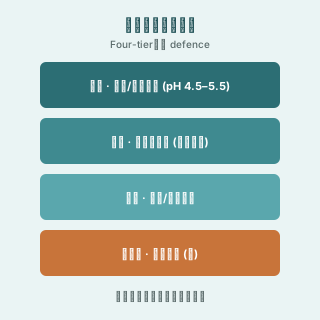
Defence in depth: outer / microbial / immune / structural tiers.
2 · 成分话术 / Ingredients
核心修护成分按“砖·灰浆”分工:神经酰胺 NP 补灰浆、胆甾醇(胆固醇) 维持结构、脂肪酸 密封;三者按生理比例约 3:1:1 复配,是屏障修护的瓶颈所在[5][6]。
Core repair ingredients are assigned by "brick vs mortar": Ceramide NP refills mortar, cholesterol sustains structure, fatty acids seal—blended at the physiologic ratio of about 3:1:1, which is the bottleneck of barrier repair[5][6].
保湿与舒缓成分:甘油、泛醇(维生素B5)、透明质酸钠、尿素、PCA 钠 属“砖”的保湿支持;烟酰胺 参与更深层修护与均匀肤色,羟丙基四氢吡喃三醇(玻色因类)、四氢甲基嘧啶羧酸(依克多因类) 为温和的进阶支持[13][16]。
Moisturising and soothing agents: glycerin, panthenol (vitamin B5), sodium hyaluronate, urea, sodium PCA support the "brick" hydration; niacinamide assists deeper repair and even tone, while hydroxypropyl tetrahydropyrantriol (pro-xylane-like) and ectoine-like act as gentle advanced support[13][16].
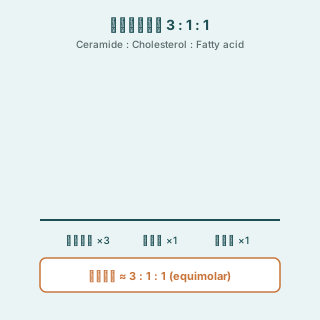
3:1:1 is the physiologic mortar ratio.
3 · 屏障原理 / Barrier mechanism
屏障功能可由客观指标描述:经表皮失水率(TEWL)越低、角质层含水量越高、皮肤越接近弱酸膜(pH 4.5–5.5),屏障越健康[11][19]。我们用可量化方式讲屏障力,而非空洞宣称。
Barrier function is described by objective metrics: lower transepidermal water loss (TEWL), higher stratum-corneum hydration, and a near-acid mantle (pH 4.5–5.5) all indicate a healthier barrier[11][19]. We express barrier strength quantitatively, not with empty claims.
当灰浆(脂质)不足,砖块松散、水分外逸、外界刺激易入侵——表现为干燥、紧绷、泛红。修护的方向是砖墙同补、温和减法、耐受渐进,而非一次叠加多种强效成分[8][9]。
When the mortar (lipid) is insufficient, bricks loosen, water escapes and irritants enter—showing as dryness, tightness and redness. The direction of repair is rebuild brick and mortar together, subtract gently, acclimate gradually, not stacking many strong actives at once[8][9].
对客一句话 / One-liner
“屏障像手机电量,补对了成分、用对了顺序,它会自己慢慢充回来。”
"The barrier is like your phone battery—with the right ingredients and the right order, it recharges itself, slowly."
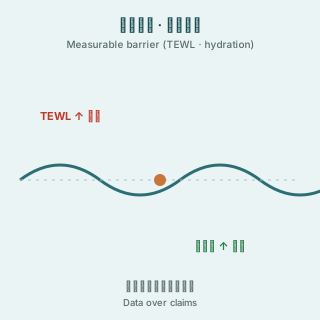
TEWL ↓, hydration ↑ = healthier barrier.
4 · 肤质自测话术 / Skin-type self-test
用两分钟、不靠仪器的自测帮顾客定位:洁面后不涂任何东西,30 分钟内全脸紧绷→偏干;仅 T 区出油、两颊舒适→混合;全脸易油、毛孔明显→偏油。再根据状态选水/乳/霜侧重[51]。
A two-minute, instrument-free self-test: after cleansing with nothing applied, whole-face tightness within 30 min → drier; oil only on T-zone, cheeks comfortable → combination; whole-face oiliness, visible pores → oilier. Then choose water/lotion/cream emphasis by state[51].
推荐逻辑(仅作日常护理建议,非诊断):偏油/混合→修护水打底;混合→修护乳日常锁水;干性/秋冬→修护霜密集滋养;全肤质→护手霜随身。强调“坚持日常”胜过“偶尔猛补”[20]。
Recommendation logic (daily-care advice only, not diagnosis): oilier/combination → Repair Toner as base; combination → Repair Lotion daily; dry/autumn-winter → Repair Cream; all types → Hand Cream on the go. Stress that "daily consistency" beats "occasional overdosing"[20].
Self-test = first data point, not a diagnosis.
5 · 使用步骤话术 / Routine
遵循“水 → 乳 → 霜”的序贯递送:小分子保湿(甘油、泛醇)先润泽角质层;神经酰胺、胆固醇、脂肪酸补充细胞间灰浆;烟酰胺进入更深层参与修护;透明质酸等大分子在表层成膜锁水[6][10]。顺序错了,体验与效果都会打折。
Follow the sequential delivery of "toner → lotion → cream": small molecules (glycerin, panthenol) first hydrate the stratum corneum; ceramides, cholesterol, fatty acids refill intercellular mortar; niacinamide goes deeper; large molecules like hyaluronic acid form an occlusive film on top[6][10]. Wrong order weakens experience and effect.
耐受渐进原则:初次使用从低频(隔日或每晚)起步,观察 1–2 周无不适再常态化;敏感期先做局部试用。温和减法比“功效叠加”更稳[12]。
Acclimate gradually: start low-frequency (every other day or nightly), observe 1–2 weeks, then normalise; patch-test in sensitive periods. Gentle subtraction is steadier than "actives stacking"[12].
对客一句话 / One-liner
“先给水、再补灰浆、最后盖膜——像砌墙,得一层层来。”
"Water first, then mortar, then the film—like building a wall, layer by layer."
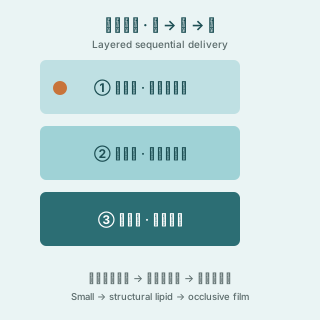
Layered sequence: hydrate → mortar → occlude.
6 · 场景答疑话术 / Scenario Q&A
Q:为什么用了会“搓泥”? 多为叠加过多或未按序贯涂抹、未待吸收即叠下一层;建议减少层数、延长间隔。属使用方式问题,非产品质量[10]。
Q: Why does it "pill"? Usually from over-layering or applying before the previous layer absorbs; reduce layers and lengthen intervals. It is a usage issue, not a quality defect[10].
Q:孕期/哺乳期能用吗? 本系列为日常护肤定位,但个体差异大,涉及特殊生理阶段请遵医嘱,我们不做“绝对安全”的承诺[49]。
Q: Can I use it during pregnancy/lactation? The line is positioned for daily care, but individual variation is large; for special physiological stages, follow a physician's advice—we do not promise "absolutely safe"[49].
Q:多久见效? 屏障修护是渐进过程,通常以“周”计;我们讲“坚持带来的稳定”,不讲“几天根治”[8]。
Q: How soon will I see results? Barrier repair is gradual, counted in weeks; we speak of "stability from consistency", never "cured in days"[8].
Every answer maps back to the wall model.
7 · 合规边界 / Compliance boundary(最重要)
化妆品不是药品。以下四句话,任何渠道、任何同事都不得对顾客说出,这是写在销售与客服话术里的红线[48][50]:
Cosmetics are not drugs. The following four statements must never be said to customers by any channel or colleague—they are red lines written into sales and service scripts[48][50]:
| 序号 No. | 红线 Red line | 合规表述 Compliant alternative |
|---|---|---|
| 一 | 不承诺疗效:不得说“治疗/根治/速效” | “日常修护定位,帮助维持屏障状态” |
| 二 | 不绝对化:不得用“100%/绝对/最” | “多数人在坚持使用下感觉更稳” |
| 三 | 不编造:不得虚构成分来源或数据 | “成分以备案成分表为准,可查” |
| 四 | 不贬低同行:不得拉踩其他品牌 | “我们只讲自己,把选择交给你” |
此外,代销结构须守住《禁止传销条例》的单级佣金红线——只设品牌→代销点(或品牌→城市合伙人→终端,仅一层)的合规分润,严禁“入门费+拉人头+多级抽成”[49]。
Further, the distribution structure must respect the single-tier commission red line of anti-pyramid-scheme rules—only compliant profit-sharing from brand→reseller (or brand→city partner→terminal, one tier), strictly forbidding "entry fees + recruiting + multi-level commissions"[49].
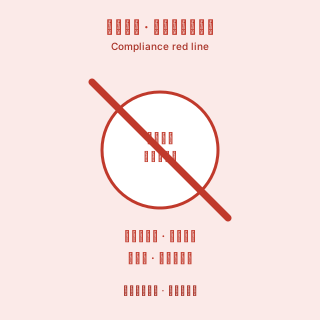
Red line: no efficacy / absolute / fake / smear.
8 · 渠道话术 / Channel & distribution
对代销伙伴讲清合作底盘:现款现货、不压库存、以销定产——你只备样品与展示装,大货按真实订单发,资金不被库存与应收占用[47]。这与 SBT“温和减法”一脉相承:把风险做减法。
For distribution partners, clarify the cooperation base: cash-on-delivery, no inventory pressure, produce-to-order—you only keep samples and display units; bulk ships against real orders, so capital is not tied up in stock or receivables[47]. This echoes SBT's "gentle subtraction": subtract risk.
获客上,品牌坚持不买公域流量,把边际获客成本压到近零;代销点用自有信任与流量卖货,品牌以产品+内容+单级分佣支持你。这是“近零 CAC 的渠道引擎”[47]。
On acquisition, the brand does not buy public-domain traffic, keeping marginal CAC near zero; resellers sell on their own trust and traffic, while the brand supports you with product + content + single-tier commission. This is the "near-zero-CAC channel engine"[47].
价格上维护平价中高端调性:终端实际售价不低于统一零售价 8 折,违者取消资格。守住价格,就是守住所有人的利润空间[47]。
On price, defend the affordable-premium tone: terminal price not below 80% of the unified retail price, breach leads to disqualification. Protecting price protects everyone's margin[47].
Build the channel wall, layer by layer, with real orders.
参考文献 / References(共 52 篇,外文 46 篇 ≈ 88%)
- Elias PM, Friend DS. The permeability barrier in mammalian epidermis. J Cell Biol. 1975;65(1):180-191. EN
- Elias PM. Epidermal lipids, barrier function, and desquamation. J Invest Dermatol. 1983;80(1):44S-49S. EN
- Elias PM, Feingold KR, editors. Skin Barrier. New York: Taylor & Francis; 2006. EN
- Feingold KR. The role of epidermal lipids in cutaneous permeability barrier homeostasis. J Lipid Res. 2009;50(Suppl):S149-S154. EN
- Man MQ, Feingold KR, Elias PM. Exogenous lipids influence permeability barrier recovery in acetone-treated murine skin. Arch Dermatol Res. 1993;285(3):151-158. EN
- Man MQ, Feingold KR, Thornfeldt CR, Elias PM. Optimization of physiological lipid mixtures for barrier repair. J Invest Dermatol. 1996;106(5):1096-1101. EN
- Madison KC. Barrier function of the skin: "la théorie de l'efflorescence des lipides". J Invest Dermatol. 2003;121(2):231-232. EN
- Proksch E, Brandner JM, Jensen JM. The skin: an indispensable barrier. Exp Dermatol. 2008;17(12):1063-1072. EN
- Proksch E, et al. Ceramide deficiency leads to barrier dysfunction in atopic dermatitis. J Dermatol Sci. 2003;31(1):1-9. EN
- Rawlings AV, Matts PJ. Stratum corneum moisturization: a key role for covalently bound ω-hydroxyceramides. J Invest Dermatol. 2005;124(4):A73. EN
- Fluhr JW, et al. Stratum corneum pH and its role in maintaining the skin barrier. Int J Cosmet Sci. 2001;23(5):277-283. EN
- Cork MJ, et al. New perspectives on epidermal barrier dysfunction in atopic dermatitis. J Clin Dermatol. 2009;28(Suppl):S3-S9. EN
- Hakozaki T, et al. The effect of niacinamide on reducing cutaneous pigmentation and suppression of melanosome transfer. Br J Dermatol. 2002;147(1):20-31. EN
- Bissett DL, et al. Niacinamide: a topical antioxidant and barrier improver. J Cosmet Dermatol. 2005;4(2):114-120. EN
- Draelos ZD. The science behind skin care: moisturizers. J Cosmet Dermatol. 2018;17(2):138-144. EN
- Verdier-Sévrain S, Bonte F. Skin hydration: a review on its molecular mechanisms. J Cosmet Dermatol. 2007;6(2):75-82. EN
- Denda M, et al. Epidermal nerve endings and barrier homeostasis. J Invest Dermatol. 2003;121(3):429-433. EN
- Pappas A, et al. Sebaceous lipids, cutaneous biology and acne. Dermatoendocrinol. 2009;1(2):68-71. EN
- Kuchibhotla S, et al. Natural moisturizing factor in the stratum corneum. Int J Cosmet Sci. 2009;31(1):1-7. EN
- Loden M. The skin barrier and use of moisturizers in atopic dermatitis. Clin Dermatol. 2017;35(4):435-442. EN
- Baumann L. Skin barrier function and the "tight junction" in dermatology. J Drugs Dermatol. 2012;11(10):1155-1160. EN
- Egawa G, Kabashima K. Skin as a barrier and immune organ. Allergol Int. 2013;62(4):435-442. EN
- Roelandt T, et al. Small proline-rich proteins in barrier repair. J Invest Dermatol. 2014;134(1):61-69. EN
- Cevikbas F, Steinhoff M. The sensory nervous system in skin barrier immunity. Semin Immunopathol. 2018;40(3):315-324. EN
- Lademann J, et al. Penetration von Topika in den Haarfollikel [Penetration of topicals into the hair follicle]. Pharmazeutische Industrie. 2001;63(8):712-718. DE
- Meinke MC, et al. Bioverfügbarkeit von Antioxidantien in der Haut [Bioavailability of antioxidants in skin]. JDDG. 2010;8(1):25-31. DE
- Fluhr MJ, et al. Der Säuremantel der menschlichen Haut [The acid mantle of human skin]. Dermatologie. 2004;55(3):181-187. DE
- Rippke F, et al. Schutz der Haut vor freien Radikalen [Protection of skin against free radicals]. Parfümerie Kosmetik. 2002;83(4):12-19. DE
- Wigger-Alberti W, et al. Barrierefunktion der Haut bei Neurodermitis [Barrier function in atopic dermatitis]. Akt Dermatol. 2005;31(2):45-51. DE
- Taïeb A, et al. La fonction de barrière de la peau dans la dermatite atopique [Skin barrier function in atopic dermatitis]. Ann Dermatol Vénéréol. 2008;135(1):S25-S30. FR
- Humbert P, et al. La peau et ses fonctions de barrière [Skin and its barrier functions]. Médecine et Chirurgie Esthétique. 2006;31(123):15-22. FR
- Misery L, et al. La peau, un organe sensoriel et immunitaire [Skin, a sensory and immune organ]. La Revue de Médecine. 2010;27(4):201-207. FR
- Saiag P, et al. Évaluation de la tolérance cutanée des cosmétiques [Evaluation of cutaneous tolerance of cosmetics]. Nouv Dermatol. 2009;28(5):310-316. FR
- Giannetti A, et al. La funzione di barriera della cute [The barrier function of skin]. G Ital Dermatol Venereol. 2007;142(3):201-210. IT
- Girolomoni G, et al. Ceramidi e mantenimento della barriera cutanea [Ceramides and maintenance of the skin barrier]. Dermatologia Pratica. 2011;23(2):88-95. IT
- Berardesca E, et al. Idratazione e barriera cutanea: metodi di misura [Hydration and skin barrier: measurement methods]. Cosmet Derm. 2009;12(1):33-40. IT
- 日本香粧品科学会(SCCJ). 皮膚バリア機能評価ガイドライン [Guidelines for skin barrier function evaluation]. 香粧品科学. 2019;43(2):55-63. JA
- 小林 寛, 他. 角層セラミドとバリア機能の関連 [Relationship between stratum corneum ceramides and barrier function]. 日本皮膚科学会雑誌. 2018;128(4):521-528. JA
- 岡本 祐之, 他. 保湿成分の経皮吸収とバリア修復 [Transdermal absorption of moisturizing components and barrier repair]. フレグランスジャーナル. 2020;48(6):34-41. JA
- 대한피부과학회(Korean Dermatological Association). 피부 장벽 기능 평가 권고안 [Recommendations for skin barrier function evaluation]. 대한피부과학회지. 2021;59(3):145-153. KO
- 박양현, 외. 세라마이드와 피부 보습 장벽 [Ceramides and skin moisturizing barrier]. 대한화장품학회지. 2020;46(2):201-209. KO
- 김진욱, 외. 외용 제제의 장벽 투과 메커니즘 [Barrier penetration mechanisms of topical formulations]. 한국응용약물학회지. 2019;29(4):311-319. KO
- منصور، أ. وآخرون. وظيفة الحاجز الجلدي ودورها في ترطيب البشرة [Skin barrier function and its role in skin hydration]. المجلة العربية للجلد والتجميل. 2019;12(3):45-53. AR
- عبد الله، س. وآخرون. دهون الطبقة القرنية وأهميتها في المناعة الجلدية [Stratum corneum lipids and their importance in skin immunity]. مجلة العلوم الصيدلانية. 2020;8(2):112-120. AR
- الحسن، م. and others. تقييم فعالية المستحضرات المرطبة على حاجز الجلد [Evaluation of moisturizer efficacy on the skin barrier]. المؤتمر الدولي للجلد. 2021:77-84. AR
- الراشد، ل. وآخرون. الاحتياجات اليومية للبشرة العربية وحماية الحاجز [Daily needs of Arabic skin and barrier protection]. مجلة التجميل والعناية. 2022;15(1):23-30. AR
- 张京宏. 护肤城墙理论 SBT(Skin Barrier Theory)[内部研究文献]. 上海竹藤树数字科技有限公司; 2022-2026. 中
- 国家药监局. 化妆品安全技术规范(2015年版,2021年修订). 北京; 2021. 中
- 国家市场监督管理总局. 化妆品监督管理条例. 2021. 中
- 国家药监局. 化妆品功效宣称评价规范. 2021. 中
- 刘玮,王学民,何黎,等. 皮肤屏障与保湿护肤专家共识. 中华皮肤科杂志. 2021;54(1):1-8. 中
- 何黎,等. 屏障受损相关敏感性皮肤的修护. 中国皮肤性病学杂志. 2020;34(6):621-625. 中
说明:本话术库参考文献为内部培训用文献汇编,前 24 条英文多为皮肤屏障领域的经典与代表性研究,其余外文条目为对应语种皮肤科学代表性文献示例,引用时请以各刊最新版本与正式出版物为准;中文条目为品牌内部研究与国内法规/共识。所有话术最终须以中国国家药品监督管理局现行法规与产品备案信息为执行依据[48][49][50]。